


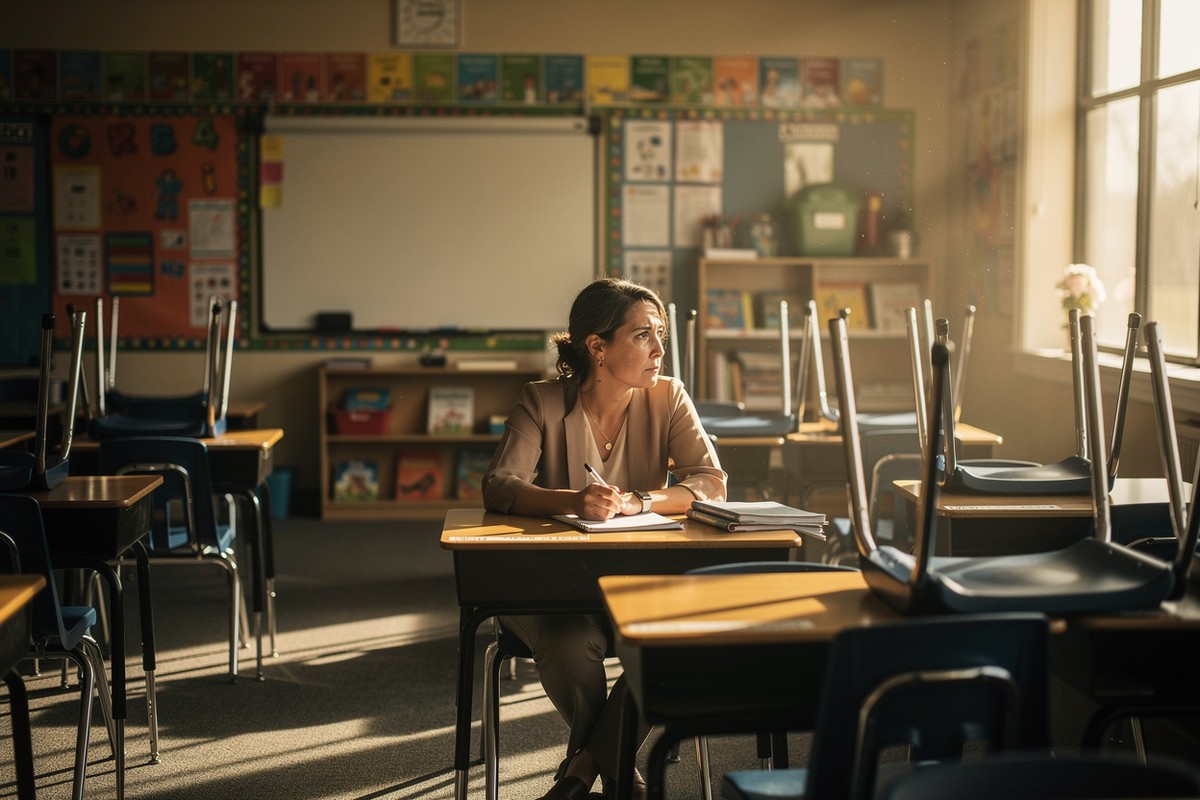
You are good at this. You make hundreds of careful judgment calls a day, and most of them never get seen by anyone. When burnout creeps in, it rarely arrives as a dramatic collapse. More often it is the quiet shift into autopilot: you are still showing up, still planning, still grading, but the thread back to why you started has gone quiet, and you are not sure where to begin to climb out.
The advice keeps missing the point
Every burnout article offers the same map: set boundaries, leave at contract time, stop grading on Sundays, try this planning hack. Reasonable advice. And if you have tried it, you already know the uncomfortable truth. You can do all of it and the heaviness stays.
That is because the standard prescription treats burnout as a workload problem. For most teachers, it is not. Plenty of people work brutal hours and do not burn out. What wears teachers down is doing emotionally demanding work, year after year, with no one engaging with the substance of it. The gap is not effort. It is reach: how often anyone with perspective actually sees your teaching and reflects it back.
The evidence has been pointing here all along
Decades of burnout research describe three components: exhaustion, cynicism, and a declining sense of accomplishment.[1] Notice that only the first is about workload. The other two are about meaning and connection: whether anyone sees your work, whether it seems to matter, whether you are in it with anyone.
The pattern holds when you widen the lens. A 2025 systematic review in European Psychiatry synthesized 40 studies of teachers worldwide and found that high workload combined with insufficient social support predicted emotional exhaustion in 75% of them. Just as notably, strong support networks, including collegial relationships and coaching, consistently buffered against burnout.[2]
That is why the boundary advice underdelivers. Leaving at 4 p.m. addresses exhaustion. It does nothing for the teacher who has not had a meaningful conversation about their actual teaching in two years. You cannot boundary-set your way out of invisibility.
Consider the day itself. A teacher makes hundreds of judgment calls between the first bell and the last: instructional, emotional, behavioral. Then the room empties, and there is no one to process any of it with. Not because colleagues do not care, but because everyone is drowning in their own room. The work is deeply social. The working conditions are strangely solitary.
Where to start when you are running on empty
If you are in the autopilot stretch right now, the instinct is to subtract: do less, expect less, wait for summer. Subtraction helps with exhaustion, but it does not touch the isolation underneath. The way back is usually addition, and it can start small.
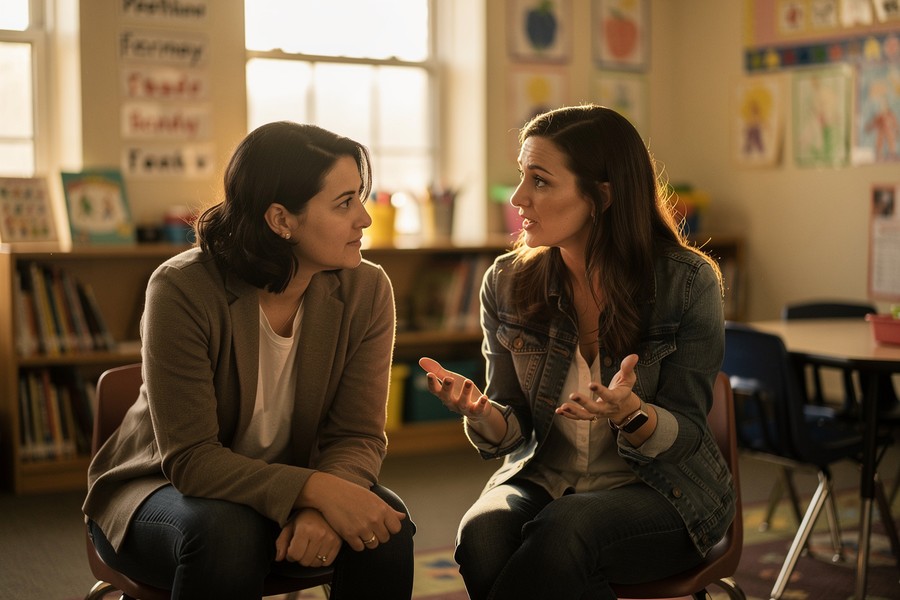
When teachers who almost quit describe what kept them, the answer is rarely a lighter workload. It is a person. A mentor who watched them teach and named what was working. A colleague who said "that happened to me too" at the right moment. An instructional coach who asked one good question that untangled a month of frustration. What those have in common is simple: someone engaged with the substance of their teaching. Not wellness-program support, pizza in the lounge or a mindfulness app license, but professional support. Being seen in the work, not just thanked for surviving it.
This is also why so much observation makes burnout worse, not better. If the only time anyone watches you teach is evaluation, a rubric, a rating, a file, then attention means judgment, and being seen becomes a threat. What burnout calls for is the opposite: attention without a verdict.
A more honest self-diagnosis
If you are burning out, set down the time-management books for a moment and ask different questions. When did someone last engage seriously with my teaching, not my compliance, my teaching? Do I have anyone to process hard classroom moments with, or do I metabolize them alone? When something works in my room, does anyone ever help me understand why?
If those answers are "years," "no," and "never," your problem was never your calendar. The first step is not a better system. It is one point of connection: a colleague you debrief with honestly, even fifteen minutes a week. A reflection habit that makes your own growth visible to you. Where it exists, a coach, a real one, there to grow you, not grade you.
You deserve to be seen in the work
This is the conviction behind everything we write here: teachers do not burn out because they care too much. They burn out when no one has the reach to see what they are carrying. The fix is not another productivity system. It is support that engages with the substance of teaching, beside the teacher, without a verdict attached.
That is what eduimpact is built to do: a second set of eyes that reflects your week back so you can act on it, with a real person reviewing what it surfaces, so you are seen and never graded. It helps you think, it does not think for you. Your judgment stays in control.
If this reframe named something you have felt, join the waitlist. One colleague who knows your classroom, for the teacher who has been carrying it without one.
Teachers do not burn out because they care too much. They burn out when no one has the reach to see what they are carrying.
Maslach, C., & Leiter, M. P. (2016). Understanding the burnout experience: recent research and its implications for psychiatry. World Psychiatry, 15(2), 103-111. https://onlinelibrary.wiley.com/doi/10.1002/wps.20311 ↩︎
El Alaiki, A., et al. (2025). The global burden of teacher burnout: Evaluating the roles of workload and social support in diverse educational contexts. European Psychiatry, 68(Suppl 1), S724. https://doi.org/10.1192/j.eurpsy.2025.1469 ↩︎