



Let me tell you what I actually do, because the title confuses people. "Instructional coach" sounds like someone who shows up to fix your teaching. New teachers hear it and brace for a verdict. Veteran teachers hear it and assume I am there to catch something. Neither is right, and the gap between what coaching sounds like and what it actually is may be the most useful thing I can clear up for you in the next seven minutes. So here is the honest version, from inside the work.
So what does a coach actually do all day
Here is the part that surprises new teachers: most of my job is not telling you things.
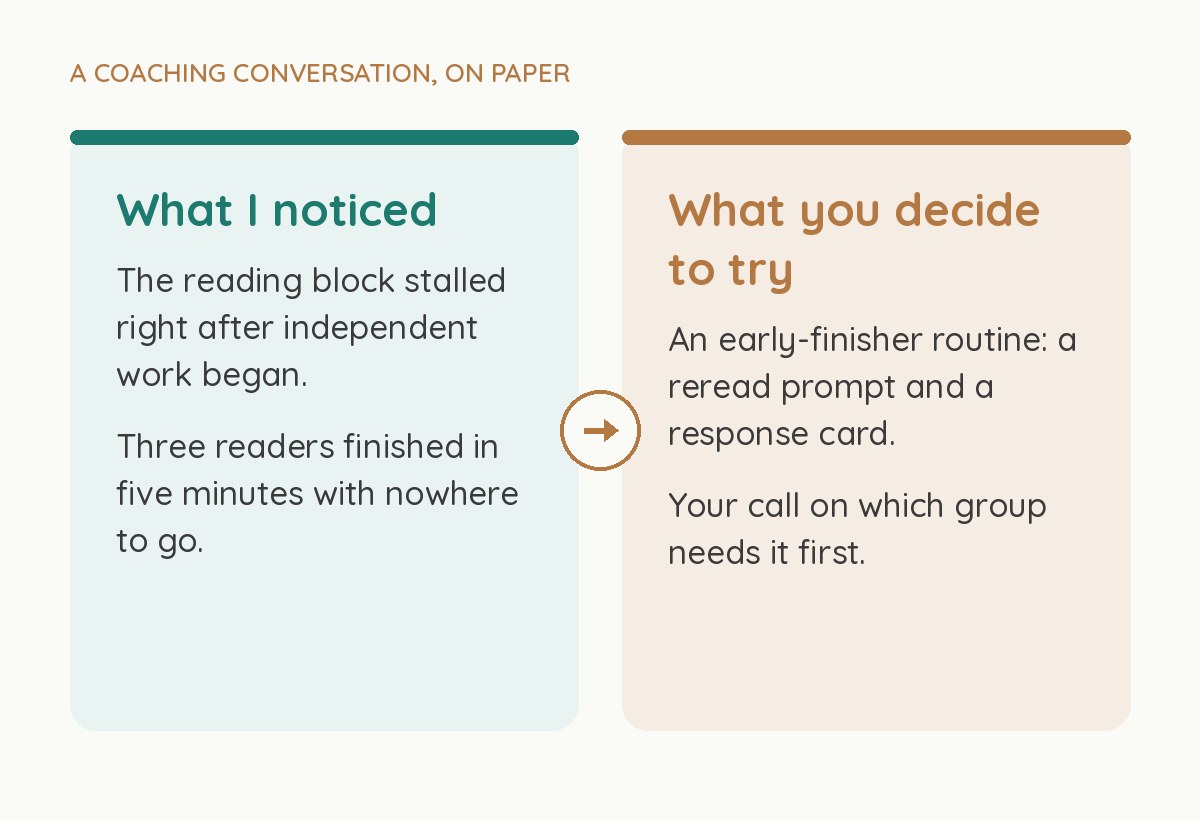
A lot of people picture coaching as a more experienced person watching you teach and then handing you a list of fixes. That happens almost never. If I walked in, watched your reading block, and left you a list, I would have made you feel watched and taught you very little. You would do the things on the list because I said so, not because you understood why, and the moment I left the building you would be on your own again.
What I actually do is help you see your own classroom more clearly than you can see it while you are standing in it. Teaching happens fast. You are making a hundred small decisions an hour while twenty-five kids pull at your attention, so you almost never get to watch yourself do it. A coach is a second set of eyes that notices what you were too busy to notice, and then hands it back to you. "When the lesson stalled, here is what I saw happen right before." That is it. I noticed, I reflected it back, and then I got out of the way so you could decide what to do with it.
The decision stays yours. Always. A good coach is not steering the car. A good coach is the person in the passenger seat saying "did you see that the road just split back there?" so you can choose your own turn with better information.
What coaching is not (because the confusion does real harm)
If you only remember one section, make it this one. Three things get mistaken for coaching, and each mistake costs teachers something.
Coaching is not evaluation. This is the big one, and it is the one that makes new teachers nervous. An evaluation rates you. It produces a score, a rating, a document that goes in a file and helps someone decide about your job. It is a necessary part of running a school, and it is usually done by an administrator. Coaching produces none of that. There is no score, no file, nothing that follows you. A coach who is also grading you is not really coaching, because you will never be honest with someone who is deciding your future. The whole thing only works if you can say "I have no idea what I am doing with this kid" out loud and know it will never be held against you. Keep those two jobs separate, and protect the coaching one.
Coaching is not professional development. PD is a workshop. Someone stands at the front and teaches a topic to a room: the new literacy framework, the new behavior system, the new platform. It is one-to-many, it is about a subject, and it ends when the session ends. Coaching is one-to-one, it is about your practice in your room with your kids, and it keeps going. PD gives you the idea. Coaching is what helps the idea actually survive contact with Tuesday morning.
Coaching is more than mentoring. This is the subtle one, and I get it wrong with new teachers all the time until I explain it. A mentor is generous and experienced and tells you how they would do it. That is genuinely valuable, especially in your first year, and a good coach is often a mentor too. But mentoring and coaching are different kinds of help. Mentoring hands you someone else's answers. Coaching makes you better at finding your own. A mentor says "here is what I do with a kid like that." A coach says "tell me what you tried, and let's look at what happened." One transfers a solution. The other builds your judgment so you need fewer borrowed solutions over time. Both have their place, and they often come from the same person. They are just not the same job.
Related readingCoaching vs. Evaluation→
Why a non-judgmental mirror makes you grow faster
Here is the mechanism, because "coaching helps teachers improve" is the kind of claim you should be allowed to poke at.
You cannot fix what you cannot see, and you cannot see your own teaching while you are doing it. That is not a flaw in you. It is just the nature of the work. The teacher is inside the lesson; the lesson is happening to her in real time. So the single most valuable thing a coach gives you is not advice. It is sight. A clear, calm, non-judgmental account of what actually happened, handed back to you while it is still fresh enough to learn from.
The non-judgmental part is not a nicety. It is the engine. The second you feel judged, you defend instead of reflect, and defending teaches you nothing. But when you genuinely trust that the person reflecting your practice back has no stake in rating you, something opens up. You get curious about your own teaching instead of protective of it. You start saying "huh, why did I lose them right there?" And a teacher who is curious about her own practice improves on her own, between sessions, long after the coach has gone home. That is the whole point. The measure of good coaching is not how much you needed the coach. It is how much sharper your own eye got.
This is also why it works for teachers who are already good. Coaching is not remediation. The strongest teachers I work with want the mirror most, because they have the least ego tied up in being told they are fine and the most appetite for the small adjustment that makes a good lesson great.
A coach does not give you answers. A coach gives you back your own classroom, clearly enough to learn from.
What if there is no coach in your building
Now for the uncomfortable truth, and the reason this article exists.
Everything I have described is what the best-resourced schools give their teachers. A trained instructional coach, protected time, a culture where reflection is safe. It is one of the most powerful things a school can do, and the research backs that up: teachers who get real coaching improve their practice meaningfully, in ways that show up for kids.1
Most teachers never get it.
The coach is stretched across forty teachers and can reach you maybe twice a semester. Or your school is small and there is no coach at all. Or you teach at a private school with no coaching structure, or you are a homeschool parent at a kitchen table, or you are the solo teacher with no colleague down the hall to lean into the doorway and ask "is it just me?" The need is universal. The access is not. The teachers who most need a second set of eyes are very often the ones working entirely alone.
That gap is not about talent or effort. It is about who happened to land in a building with the resources, and who did not. And it is the gap worth closing.
Related readingThe First-Year Homeschool Field Guide→
Where eduimpact comes in
This is the gap we built eduimpact to close. Not to replace the coach in the building. To give the reflective coaching the best schools give their teachers to the educators who do not have a coach in the building at all.
You bring the hard moment: the reader who finishes in five minutes and derails everyone else, the lesson that fell flat, the parent meeting tomorrow you are dreading. You get a coaching response grounded in real K-5 practice and shaped by real coaches, the same kind of "here is what I would look at" reflection you would get from a good coach down the hall. It does not grade you. It does not watch you. It does not decide anything about you. Your judgment stays in charge, exactly where it belongs. The coaching just gives it company.
That is all coaching ever was. Someone beside you, helping you see your own classroom clearly, so you can decide what to do next. We just made it reachable for the teachers who never had it.
Sources
The claim that teachers who get real coaching improve their practice, in ways that show up for kids, rests on the largest causal review of the research to date.
- Kraft, M. A., Blazar, D., & Hogan, D. (2018). The Effect of Teacher Coaching on Instruction and Achievement: A Meta-Analysis of the Causal Evidence. Review of Educational Research, 88(4), 547–588. Combining 60 studies that used causal research designs (largely randomized controlled trials), the authors found pooled effect sizes of 0.49 standard deviations on instruction and 0.18 standard deviations on student achievement, with much of the evidence coming from literacy coaching for pre-kindergarten and elementary teachers. Journal (DOI) Open-access working paper Practitioner summary (ERIC)