



Do the arithmetic on your own building. Sixteen teachers, give or take. One head of school who is also handling admissions, the boiler, and a parent email that arrived at 10:40 last night. A veteran second grade teacher everyone quietly goes to. Nowhere on that list is a person whose actual job is to sit in your room, watch you teach, and come back on Thursday to ask how the change went. Not because anyone decided it did not matter. Because there was never a headcount for it.
The number nobody puts on a slide
When people talk about instructional coaching, the picture in their head is usually a big building with a coach in an office near the front. That picture is wrong for most of American education.
According to the most recent Private School Universe Survey, there were about 29,730 K-12 private schools in the country, enrolling roughly 5.5 million students, taught by about 482,570 full-time equivalent teachers.[1] Divide it out. The average private school enrolls 184 students. The average faculty is around sixteen people. For schools with no religious affiliation, the average enrollment is 138.
Sixteen teachers is a real school. It has a first grade and a fifth grade and a music teacher and a hallway that floods when it rains. It also sits in a specific and awkward spot. It is too big for the head of school to genuinely be in every classroom every week, and too small to carry a full-time coaching line without taking that money from something a parent can see.
So the role does not get filled. And because it does not get filled, coaching starts to sound like something other schools do. It becomes a thing you would get to if you were bigger, filed next to a second gym. We wrote about how that absence actually feels from inside a building in The Quiet Problem in Private Schools.
That framing is backwards, and the research is the reason.
The evidence came from schools your size
The closest thing we have to a settled answer on whether coaching works is a meta-analysis by Matthew Kraft, David Blazar and Dylan Hogan, which pooled 60 studies that used causal research designs. Across those studies, coaching moved instructional practice by 0.49 standard deviations and student achievement by 0.18 standard deviations.[2] For an intervention aimed at adult professional practice, those are strong numbers, and most of the evidence comes from literacy coaching in pre-kindergarten and elementary grades, which is to say from rooms that look like yours.
Here is the part that rarely gets quoted. When the same authors sorted the programs by size, the small ones did substantially better. Programs enrolling fewer than 100 teachers and run by a few coaches produced effects roughly twice as large as programs enrolling more than 100 teachers with many more coaches.
Hold that finding carefully, because it is easy to over-read. The small programs were mostly efficacy trials, run close to the researchers who designed them, with tighter implementation and better resourcing than a scaled program gets. Size was not the only thing that differed. So this is not proof that being small makes coaching work better.
What it does say, plainly, is that coaching is not a robust intervention you can spread thin and expect to hold. Its effect depends on the quality of a specific relationship and the consistency of a specific loop. Stretch one coach across a hundred teachers and most of what made it work evaporates.
Which means the thing a small school lacks is not the conditions. You already have the conditions. Fifteen colleagues you actually know, a hallway short enough to cross in twenty seconds, no layer of bureaucracy between noticing something and saying it. What you lack is the position.
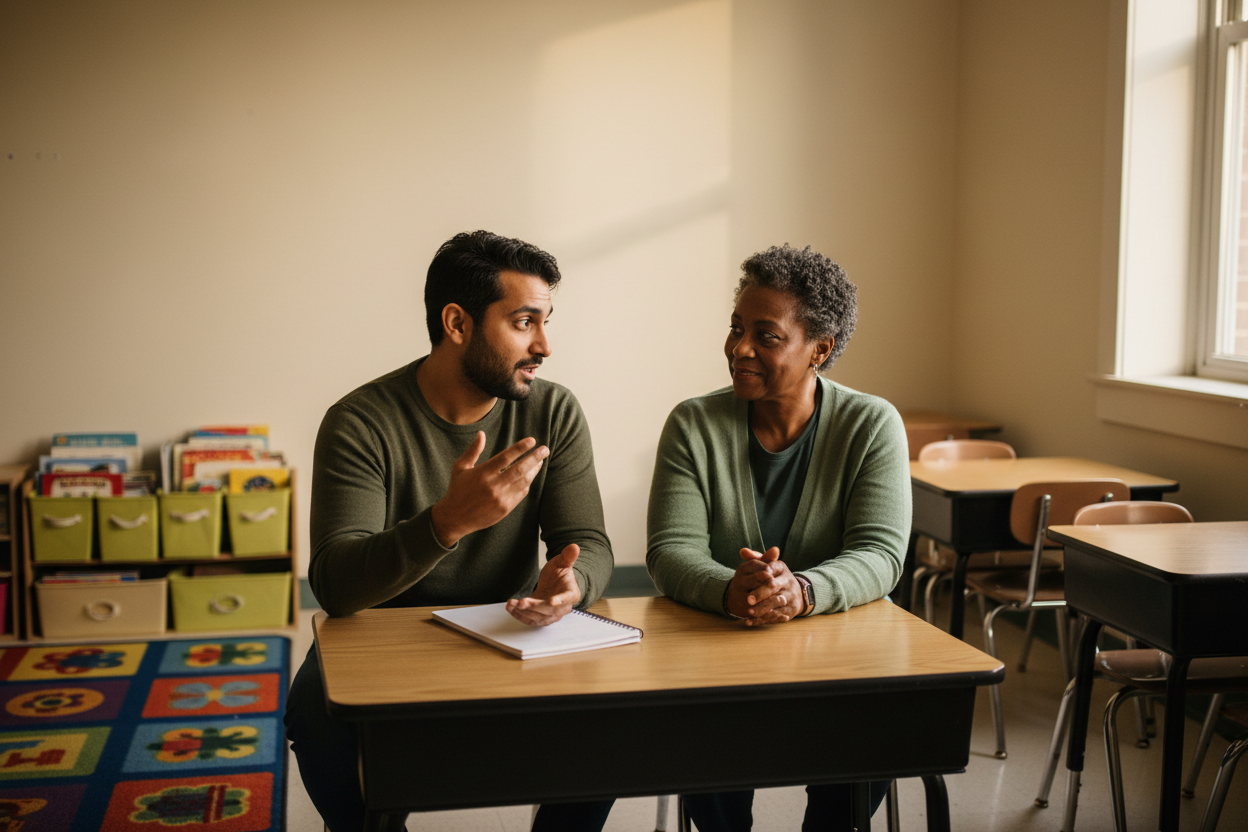
Unbundle the role before you try to fill it
"We cannot afford a coach" ends the conversation early, because it treats coaching as one indivisible thing you either buy or do without. It is three jobs, and they come apart.
Somebody watches. A person sees the lesson, or a recording of it, with attention free enough to notice what the teacher could not. This is the part small schools are best positioned for and worst at scheduling, because everyone who could watch is teaching at the same time you are.
Somebody describes. They say back what happened in plain description, not verdict. "Your first three questions after the read-aloud were all recall questions" rather than "questioning needs work." This is a learnable skill and most people have never been taught it, which is why informal feedback in small schools so often arrives as either praise or a fix.
Somebody comes back. A week later, the same person asks how the change went. This is the whole thing. It is also the job that disappears first, in every school of every size, because nothing on the calendar protects it. A workshop ends. An observation gets filed. Nobody circles back, so nothing compounds.
Look at your building against those three. You will usually find that watching happens occasionally, describing happens accidentally, and coming back does not happen at all. That is a more useful problem statement than "we have no coach," because two of the three are schedulable and free.
What small schools can actually do
Four options that do not require a new position. None of them are complete. Ranked by how quickly you can start. If you want the version of this written for the individual teacher rather than the school, it is in What to Do When Your School Doesn't Have a Coach.
Trade observations with one colleague, on a schedule. Not a drop-in culture, an actual recurring thirty minutes on a calendar, with a named partner. Bring one question to it ("watch my transitions into small group") so your partner has a job narrower than judging you. The narrowness is what makes it safe, and safety is what makes it honest.
Record yourself and watch it once a month. Uncomfortable, and the single cheapest way to see what you actually did rather than what you remember doing. Watch it with the sound off once. You will see the room differently.
Share a coach across schools. Two or three small schools in the same city, one coach splitting the week. Not as good as a full-time coach in your building, considerably better than nothing, and the math works at a size where it will not work alone. This takes a phone call to a peer school, which is the hard part, since it means admitting you both have the same gap.
Put the follow-up on the calendar, in writing. Whoever observed, whatever they said, the return conversation gets scheduled in the same breath. Fifteen minutes, eight days later. This costs nothing and is the highest-yield thing on this list, because it is the job that otherwise vanishes.
eduimpact is one more option, and we will get to it. It belongs on a list like this one, not above it.
If you are the one who decides
A note for the head of school or the person carrying the growth of a faculty, since you may be reading over a teacher's shoulder.
The question is usually framed as whether the school can afford a coaching position. Reframe it. Ask instead who currently holds each of the three jobs above, and be honest that for follow-up the answer is nobody. That is a gap you can address this year without a hire.
Two cautions worth naming. The first is that the person who evaluates cannot be the only person who observes. When the same individual writes your letter and watches your lesson, teachers show the version that scores well, and the version that scores well is not the one that needs help. We wrote about why that instrument is the wrong one in Coaching vs. Evaluation. The second is that a small faculty gives you something a large one cannot buy, which is the ability for support to be genuinely specific to your school's culture rather than a framework imported wholesale. Protect that. It is the actual asset.
How eduimpact fits, honestly
We built eduimpact for the school with sixteen teachers and no coach, so here is the plain version of what it does and does not do.
It covers the watching and the describing. It reflects your teaching back to you in description rather than judgment, so you are working from what happened instead of what you remember. Then it covers the part that always drops. It comes back and asks how the move landed, and it keeps asking, which is how anything compounds.
A real person reviews what the system surfaces, so you are never working from a black box. Nothing is rated. Nothing is ranked. Nothing goes to whoever decides your contract. Student data can stay inside your building. And there is a private journal in it that is never sent to the AI at all, because some of your thinking should stay entirely yours.
It is not a coach and we are not going to call it one. If your school has an instructional coach, this extends how far she can reach, so she is in the loop with more than a fraction of the faculty. If your school does not have one, this is a second set of eyes that shows up on a Tuesday, which is more than most small schools have ever been able to offer.
We are reviewing applications now for our first group of K-5 educators. If that sounds like your building, join the beta waitlist.
You are not too small for coaching. You are too small for a coaching headcount. Those are different problems with different fixes.
U.S. Department of Education, National Center for Education Statistics, Private School Universe Survey (PSS), 2021-22. Digest of Education Statistics 2023, Table 205.45. https://nces.ed.gov/programs/digest/d23/tables/dt23_205.45.asp ↩︎
Kraft, M. A., Blazar, D., & Hogan, D. (2018). The Effect of Teacher Coaching on Instruction and Achievement: A Meta-Analysis of the Causal Evidence. Review of Educational Research, 88(4), 547-588. https://doi.org/10.3102/0034654318759268 ↩︎