



Search "homeschooling lonely" and most of what comes back is about the kids: socialization tips, co-op directories, playdate schedules. Useful, but it quietly skips the person who typed the search. Because here is the truth a lot of homeschool parents will not say out loud. It is not always the child who is lonely. It is you. You can be surrounded by your children all day and still feel profoundly alone in the work. Alone in the planning. Alone in doubt. Alone at 9 p.m., googling whether other kids also melt down over copywork, because there is no colleague to ask. If that is where you are, this is not a character flaw or a sign you have chosen wrong. It is structural. And naming the structure is the first step to fixing it.
The loneliness is built into the job description
Think about what a school provides for a teacher besides a paycheck: a staff room, a mentor, a grade-level team, a hallway of people who get it. Strip all of that away and keep the teaching, and you have homeschooling. The work came home; the colleagues did not.
This is not a soft observation. Researchers who study teacher wellbeing have found that collegial support, the everyday presence of peers who share the load, acts as a buffer against the stress and burnout built into teaching.[1] Take that buffer away and the strain has nowhere to go. Homeschool parents are attempting the same craft with a support structure of close to zero, and the data on parents generally tells the rest of the story. In a 2024 national survey, two in three parents said the demands of parenthood often feel isolating and lonely, and nearly two in five said they have no one to support them in the role.[2] The U.S. Surgeon General went further the same year, naming parental stress and isolation a genuine public health concern.[3] The surprise is not that homeschooling feels isolating. The surprise is that anyone expected it not to.
More curriculum won't fix it
When the loneliness bites, the instinct is to buy something. A new math program. A planner with better stickers. A subscription box. Curriculum is the thing homeschool culture knows how to sell, so it gets prescribed for everything, including problems it cannot touch.
But the gap is not materials. You likely have more curriculum than you can use. The gap is feedback and a thinking partner. Someone to tell you that the lesson flopping was not your fault, or that it was, gently, and here is what to try tomorrow. Someone to reflect the week back to you so you can see your own teaching clearly instead of through the fog of doubt.
What actually helps
A few things consistently move the needle, and none of them come shrink-wrapped.
Find one real peer, not a feed. A single homeschool parent you can text honestly beats five hundred Instagram accounts that make you feel behind. Look for the parent one or two years ahead of you, close enough to remember, far enough to reassure.
Make the invisible work visible. Loneliness feeds on the feeling that nobody sees the effort. A simple end-of-day note, what worked, what did not, two sentences, gives your work a witness, even if the witness is you. Over months it becomes proof of growth you can actually point to.
Borrow a teacher's habit: debrief the hard days. When a lesson goes sideways, classroom teachers process it in the doorway with a colleague. You can build the same loop deliberately, with your one real peer, with a spouse who has learned to listen before solving, or with a structured reflection practice that asks you the questions a good colleague would.
And drop the standard of the imaginary classroom. Some of the loneliness is not social. It is the quiet conviction that a "real teacher" would be doing this better. They would not. They would be doing it differently, with twenty-five kids and a planning period. You are allowed to measure yourself against your own last month, not a fantasy.
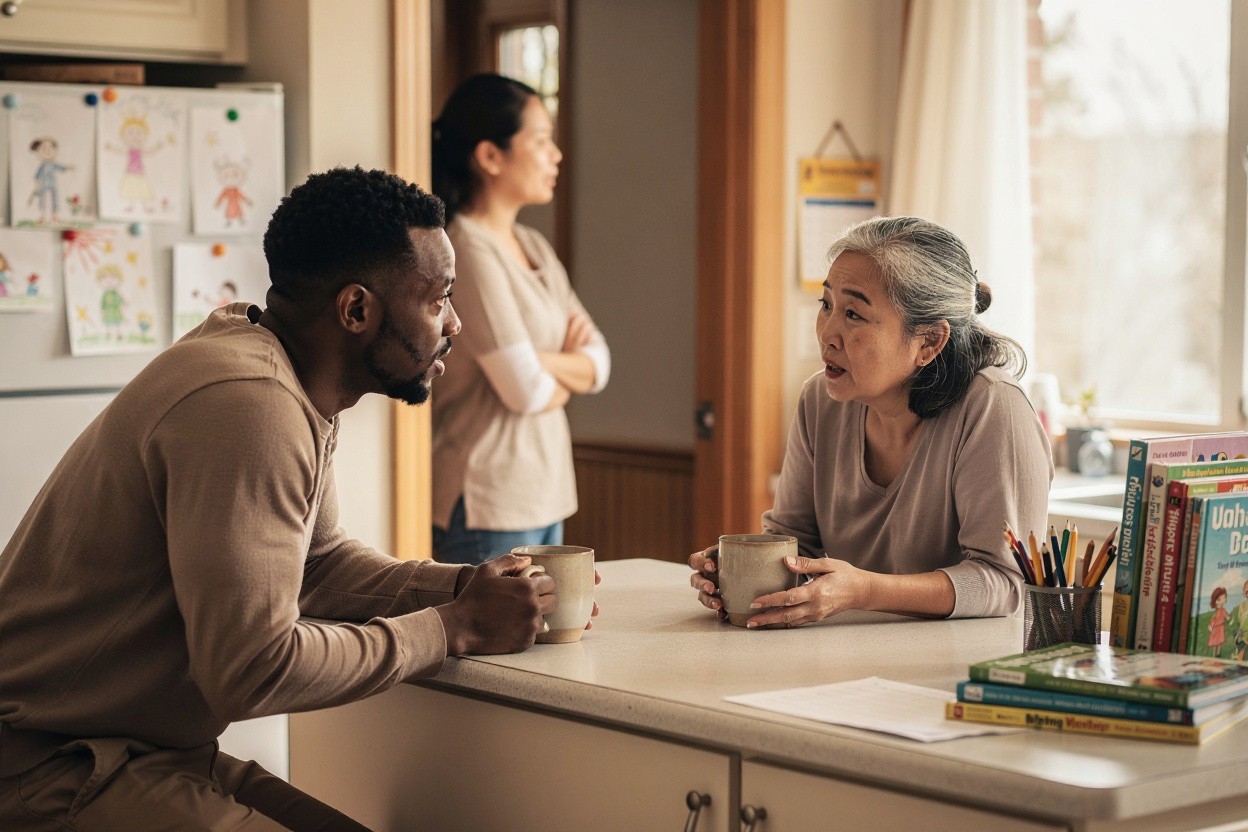
The missing piece is a colleague, not a product
Here is the reframe we keep coming back to: homeschool parents do not need another thing to teach with. They need what every teacher needs, someone in their corner who knows their classroom. That is the conviction behind eduimpact, and it is what this blog is for: writing honestly about the support side of teaching that the curriculum catalogs skip.
That is also what eduimpact does in practice. It is a second set of eyes on your week, reflecting back what happened in your room so you can see it clearly and decide what to adjust. A real person reviews what it surfaces, so you are never talking to a black box, and nobody is rating or ranking you. Your call stays yours. You just stop making it alone.
If this hit home, you are exactly who we built it for. One colleague who knows your classroom, for the educator who is doing a deeply social job with no one in the doorway.
Homeschool parents do not need another thing to teach with. They need what every teacher needs, someone in their corner who knows their classroom.
Clayback et al., "Teachers Supporting Teachers: A Social Network Perspective on Collegial Stress Support and Emotional Wellbeing," National Library of Medicine (PMC). https://pmc.ncbi.nlm.nih.gov/articles/PMC9294850/ ↩︎
The Ohio State University Wexner Medical Center, "New survey finds loneliness epidemic runs deep among parents" (2024). https://wexnermedical.osu.edu ↩︎
U.S. Surgeon General, "Parents Under Pressure: Advisory on the Mental Health and Well-Being of Parents" (2024). https://www.hhs.gov/sites/default/files/parents-under-pressure.pdf ↩︎